
Navora
Everyone gets chosen eventually.

“The cold in this town felt permanent. Not weather. Something underneath it.”
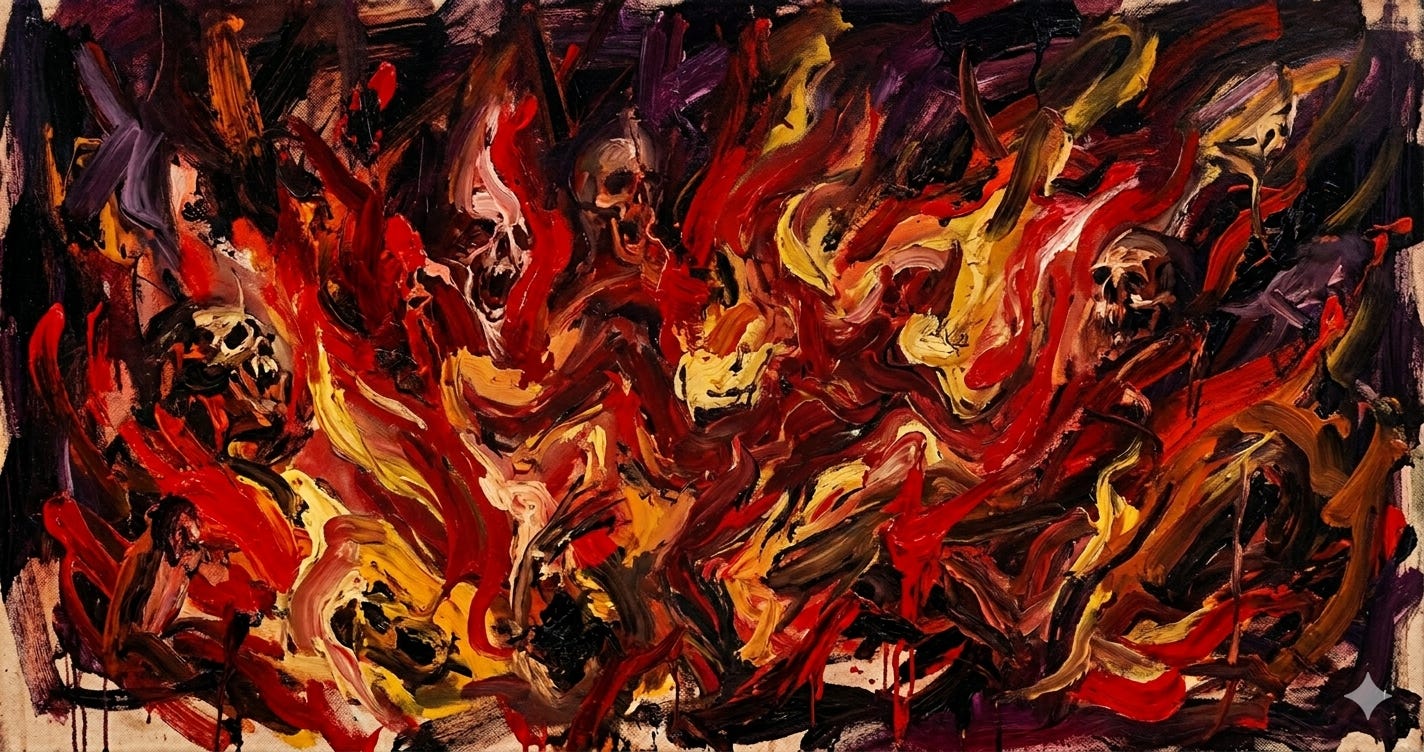
Forgetting is an illustrious psychological tactic that I wish I had better mastery of. Especially here, in Navora, where my mother once insisted the dead learned to walk through fire.
The town sits in the crevasse of a valley crushed by mountains on either side, a circumstance that obscures the sun most of the day. Everything appears dimmed except the residents, whose complexions resemble untouched notebook paper.
Dark canals cut through Navora like veins. Heavy stone bridges allow the pale denizens to drift above the moving blackness below. I kept looking down as I made my way toward the hotel.
Each time I felt a little colder.
A little less present.
Here’s hoping my room has working light bulbs.
The hotel caretaker was a lean, morose man with a face like melted candle wax. He barely had the strength to point me toward the top floor.
Walking away, I smelled decay on him.
Not sweat.
Not illness.
Something older.
Walking up a spiral staircase, the weight of the hotel announced itself in the giant stone slabs silently staring at my comparably paltry body. I was an ant in a great temple built by giants, claustrophobic yet expansive with an unmistakable sense of immortality.
My room opened beneath a great dome. Looking out the window, I felt like I was inside the head of a creature observing the rest of my body. My swirling, black tentacles splayed generously across town, gagging it into submission.
Of course there were no light bulbs.
The fireplace would have to suffice.
And now, I suppose, I should explain why I came here.
—
The story is regrettably simple.
Ordinarily I avoid discussing the inner architecture of my mind, but the fire is dancing against the stone walls now and something about the shadows makes confession feel easier.
My mother was recently hospitalized after another schizophrenic episode.
She managed to keep the illness buried most of the year, but every summer something inside her surfaced. I used to think it was cruel that the world grew brighter while her mind darkened.
This latest episode ended with attempted arson.
According to the arresting officer, she tried to set her nurse on fire while chanting something he refused to repeat.
When I visited her, the woman behind the reinforced glass barely resembled my mother. Her eyes had lost their violent blue intensity. Gray had begun invading her dyed red hair.
So I ran or perhaps I followed, hoping to put as much distance between the point of depression and my fragile state of mind. But why Navora? My mind is still dense with uncertainty...maybe one more log on the fire.
I knew about this place from my mother’s stories. She spoke of this town with great admiration and a hint of dread in the jut of her lower lip. The great cleansing, a purge, a downpour of flames, these words branded themselves into my frontal lobe, mostly due to their inherent drama and naturally these theatrics gave birth to curiosity.
I learned later that she had been speaking about the summer solstice festival held here every year. The longest day of the year.
An important event in a town where sunlight is treated almost like mythology.
Every old culture found a reason to worship the sun. Fertility rituals. Bonfires. Dancing. Singing.
But standing inside Navora, surrounded by black water and towering stone, it was difficult imagining joy surviving long here.
The cold in this town felt permanent.
Not weather.
Something underneath it.
Either way I needed sleep. The festivities would begin tomorrow.
—
My sleep was black and endless.
Then came the drums.
Bagpipes screamed through the window hard enough to drag me awake.
Looking outside, I almost failed to recognize the town.
Navora’s bleakness had been replaced with ferocious merriment. A mosaic of people blooming on each stone island, vibrating with activity. Music collided with shouting and laughter while smoke climbed into the glaring summer sky.
Everyone wore white.
From above, the crowds resembled sentient snow gathered around enormous bonfires.
The canals appeared even darker now.
In the middle of the stark whiteness was a large bonfire, perfectly centered and magnetic in its presense. Clearly this was the place to be so I threw on my white shirt hoping to melt into the party quickly but something unusual caught my eye just as I was about to exit.
To my left, a few islands over from the flame was a disturbance in both the color and human palette. Enormous creatures ambled along in a bizarre stomping dance, a circle of oddity in a sea of bleach.
Bulky copper bells hung from their midriff chiming in unison with the savage rhythm while bagpipes screeched in the background.
Their heads varied grotesquely.
Birds.
Goblin faces.
Featureless dolls.
Their bodies were just as diverse, a few had gangly arms that dragged on the floor like a puppet whose ventriloquist had abandoned it. Others were great, fat barrels of fur, a direct opposition to the slim sticks, with elaborate forest-flower decorated robes next to them.
Nobody recoiled.
Nobody even stared.
The townspeople parted for them casually, still singing, still drinking.
That frightened me more than the costumes themselves.
—
Sweat gathered beneath my arms as I hurried downstairs.
The caretaker was nowhere to be found.
I pushed open the hotel doors and staggered into blinding sunlight.
My eyes adjusted slower than expected as I stumbled into the monotone byways. The sun stood above town with rays that were magnified by the pulsating white blanket surrounding me.
As my vision adjusted, I noticed how different the townspeople appeared beneath the sun. The same dead-eyed faces now moved with strange vitality.
The sunlight injected them with energy yet they still held on to a strong sense of macabreness, as their white garb made them look like homogeneous phantoms.
I searched for the costumed figures while wandering deeper into the celebration. Smaller fires had appeared throughout the islands. People laughed as they leaped over them, sometimes alone, sometimes hand in hand.
When robes caught fire, the crowd only cheered louder.
The entire town smelled of smoke and sweat.
Music pounded through the stone streets like a second heartbeat.
Eventually I collided with a woman wearing an elaborate wreath woven from branches and flowers. Looking around, I realized all the women wore them.
I needed a drink.
I pushed through the crowd toward a wooden stand and grabbed one of the mugs waiting beside the barrels.
As I reached for my wallet, the bartender seized my wrist.
“We don’t pay today.”
His voice was low enough to vibrate.
A white imprint remained on my skin after I pulled away.
For a moment the music around us disappeared.
Then it all rushed back at once.
Laughter.
Drums.
Heat.
The bartender released me as though nothing had happened.
He was built like an ox.
I decided not to argue.
—
To my right stood a young couple I recognized from earlier.
They had been jumping over one of the fires.
“You’re not from around here, are you?” the girl asked.
I explained myself briefly and eventually asked about the creatures moving through the festival.
“Those aren’t beasts,” she laughed.
“Kukas. Costumes.”
She drank deeply before wiping her mouth with the back of her hand.
“It’s their turn this year.”
“What does that mean?”
“Everyone gets chosen eventually.”
Her boyfriend grinned drunkenly.
“You’re too pretty to worry about that.”
Then he kissed her and the conversation ended there.
—
I stayed near the stand longer than intended.
The cups beside me multiplied while the celebration intensified around us. My thoughts kept circling back to my mother.
Why had she spoken about this place with such fear?
The townspeople treated everything casually.
The costumes.
The fires.
The bells.
Maybe madness had transformed ritual into prophecy inside her mind.
Then I heard the bells again.
Louder now.
The crowd shifted as the kukas approached through the streets in a violent rhythm of fur, wood, and metal.
Knowing they were human no longer comforted me.
The feeling in my stomach was older than logic.
The creatures moved closer.
Massive fur-covered figures marched at the front while horned black-and-white demons carried long wooden staffs between them.
But my attention fixed on the tall doll-like creature at the center.
Its blank face tilted toward me.
Then it approached.
The creature carried a wreath unlike the others.
Green at the base.
Violently yellow at the top.
The flowers resembled tiny suns.
Before I could speak, it lowered the wreath onto my head.
Then the thing spoke.
“Eternal youth begins with an end.”
Its voice sounded crowded.
As though a hundred people were trying to speak through the same throat.
The procession continued onward.
Behind them walked a smaller group of people wearing the same yellow-crowned wreaths.
Without understanding why, I followed.
—
The rest of the day dissolved strangely.
Fragments remain.
Drinking.
Walking.
Crossing bridges.
Watching more fires bloom throughout the town.
At some point the celebration below us became distant.
We had reached the outskirts of Navora.
The mountains surrounding the valley rose sharply upward, and soon we were climbing narrow paths through freezing wind.
Dusk settled slowly over the valley.
I paused once to look back.
From above, the town glowed with scattered fires resembling stars fallen into the earth.
Then I saw the crater.
A vast opening carved into the mountainside.
One of the horned figures shoved me gently toward it.
A kuka waited near the entrance, towering beneath the darkening sky. As we approached, flashlights were distributed among us.
Mine trembled visibly in my hand.
—
The mountain swallowed us slowly.
Flashlight beams crawled over the stone walls as we descended deeper into the heat beneath Navora.
Soon the tunnel opened into a cavern vast enough to resemble a buried cathedral.
And there, at its center, stood the fire.
At least thirty feet high.
Waiting.
Beside it stood three figures.
One of them was the hotel caretaker.
Silver robes hung from his skeletal frame.
Seeing him there filled me with immediate regret.
I should have trusted my instincts the moment I smelled death on him.
Instead I followed him underground.
The singing began before I could think further.
Low voices.
Ancient voices.
The sound vibrated through my ribs.
People around me sang about rebirth.
About the endless wheel.
About cleansing.
The caretaker lifted his hands toward the stone ceiling and began speaking.
Most of it was unintelligible.
But one phrase repeated itself often.
Everlasting cleansing.
Then he gestured toward the fire.
The first figures stepped forward willingly.
And walked directly into the flames.
Their screams lasted only seconds.
Afterward there was nothing left except ash.
The crowd watched in reverent silence.
That was the moment something inside me broke.
Not sanity.
Resistance.
—
The caretaker lifted his arms again.
Another song thundered through the cavern.
Then everyone ran.
Not away from the fire.
Toward it.
The crowd surged forward in ecstatic silence.
And suddenly my body moved with them.
I expected panic.
Instead I felt relief.
Pure and overwhelming.
The ash beside the flames no longer horrified me.
It comforted me.
My mother had been right.
The bells screamed.
The cavern shook.
The heat wrapped itself around my face.
“It all begins with an end,” the caretaker cried.
I believed him.
As the flames rushed toward me, I thought briefly of the townspeople leaping over fires in the streets below.
A celebration.
A rehearsal.
Then I jumped.
—
...
Forgetting is an illustrious psychological tactic that I wish I had better mastery of. Especially here, in Navora, where my mother once insisted the dead learned to walk through fire…
More stories are coming.
A paid tier is arriving soon
for readers who want longer fiction,
drafts, private notes and exclusive pieces.
Wow. Your writing is so captivating and powerful. Reading your work feels do refreshing in the best kind of way, like you're not writing to impress or play into a particular current fad, you know, that particular brand of over done garbage, with it's usual clichés, subjects and themes, all playing out in the same unoriginal, predictable way, and seems to be so prevalent throughout so much of the current writing that's being done today. Your writing comes through as "not intended to please" or fit into some currently trending fan base. But rather, that what you write is something of which needed to be told, a story or idea that you felt compelled to write down. Not for any other purpose than words in which had to be told. So yeah, basically I very much enjoy reading your work, and find it so authentic and so profound 🫶
Navora feels less like a setting and more like a psychological condition—an external landscape shaped by memory, inheritance, and dread. The contrast between darkness and celebration, decay and vitality, creates a persistent unease that lingers long after the scene ends. There is a fascinating idea beneath the horror here: that people will normalize almost anything if they have lived alongside it long enough. That, for me, was far more unsettling than the creatures themselves.